

Entry 03 - Enough
Most arrivals lose count by the third week. She's been here a day. Already asking questions he doesn't have answers ready for.
She asked.
Morovka had wondered if she would. Most arrivals did one of two things: either asked too much too quickly, spilling questions like people who hadn’t learned yet that this place answered in its own time, or said nothing and called it dignity. Either way the house knew what to do with them.
She had done neither. She had waited. And now she asked the one thing she’d almost asked before and hadn’t.
The Keeper’s face didn’t change. It never did. This was, Morovka noted, a considerable effort. Not visible to most people - the surface held perfectly, the face exactly what it always was. But the stillness had increased in the specific way it increased when he was buying time. That was the thing about him - years of practice had made the surface so consistent it had stopped being a choice and become a condition. Useful, in a house like this. Morovka had found it useful anyway.
He had an answer prepared. He kept answers ready the way some people kept a spare key - not because they expected to need it, but because not having one felt like a kind of exposure. It was safer to have one. That was part of how he worked - how he had always worked, long before Morovka had become the place he worked in. The answer was correct. It was also, in every way that mattered, empty.
He gave it anyway. Of course he did.
Morovka noted this and moved on. It had more interesting things to observe.
“Enough for what?” you ask.
The words come out steadier than you expected. You hadn’t planned to say it out loud. It just came out, which is probably the most honest thing you’ve done since you got here.
He looks at you with the same focused, unhurried attention he’s had since you woke. Nothing shifts in his face. When he speaks, his voice is even and measured, carrying the particular tone of someone who has thought carefully about exactly how much to say.
“Enough to understand where you are,” he says. “Enough to find what you need when you need it.”
You hold that for a second.
It’s not wrong. You can feel that it’s not wrong - nothing trips the wire, nothing misaligns. And yet it sits in the air between you like something that’s been placed rather than said. Deliberate. The answer shaped not to inform but to satisfy, and doing neither particularly well.
You don’t look away.
A beat passes. Then another.
Not long enough to become something, not long enough that either of you would need to acknowledge it afterward. Just long enough for both of you to register what it was. The space where more could have gone but didn’t. You watch him feel the edges of it and you let him feel that you feel it. Then you let it go.
You look back at the shelves.
“Alright,” you say.
It was not alright.
Morovka appreciated the economy of that word. One syllable doing the work of a paragraph. I heard you. I know what you did. I’m not making this a scene. Don’t think I missed it.
It was alright in the sense that she had decided, for now, not to press - which was a different thing entirely and considerably more interesting. The Keeper knew this too. Morovka watched the knowledge move through him and get quietly managed.
He’d expected acceptance or push-back. He got neither.
He had been so certain, when she arrived, that he knew what kind of person she was.
He was becoming less certain. Morovka could see that too.
Morovka noted this the way it noted most things - without a particular feeling - and returned its attention to the rest of the house, which had its own business to attend to.
You turn back to the room.
The shelves going back into the dim. The lamp doing its source-less thing. The table with its arrangement of objects you haven’t touched yet.
You’re aware of him still in the doorway. Of the weight of his attention on your back, steady and practiced. Something else underneath it now that wasn’t there before. You can’t name it yet. You file it.
You’re looking at the shelf where you left The Hyphen when something moves at the edge of your vision.
Not in the room. In the corridor behind him, through the gap of the doorway. A shape, crossing fast. There and gone before you’ve fully registered it. No sound. Just the fact of movement, a presence that didn’t slow down or look in or give any sign of having noticed this room or you in it at all.
You look at the doorway.
He shifts slightly. Not turning, not acknowledging. But the shift is its own acknowledgment. Something in him has registered that you saw it.
“There are others here,” you say. Not a question this time.
“Yes,” he says. Like it’s the simplest thing you’ve asked him, which it probably is.
You look back at the corridor. Empty. The shape already gone wherever shapes go in a house this size, absorbed back into the silence of its corridors.
Others. Moving through these halls. Living here, or passing through, or something else entirely - you don’t know yet. Alongside whatever this place is and whatever it does.
You look back at the nearest shelf. You notice, for the first time, that some of the objects have small labels. Not titles. Just numbers. You don’t ask about those either.
Something shifts in you. Small. The spark those two objects lit, which has been sitting uncertain in your chest since you set them back on the shelf, catches slightly. Not into flame. Just into something more stable than it was. A direction. Not a destination, just a direction.
You want to know who else is here. What they found when they arrived. Whether any of them stood in this room and felt what you felt reading those two lines.
You don’t ask any of this.
You look at him and find him already looking at you with the careful attention of someone trying to read something in a language they don’t yet have the alphabet for.
“I’d like to see more of the house,” you say.
A pause. Short. The briefest flicker of adjustment.
“Of course,” he says. And steps back from the threshold to let you through.
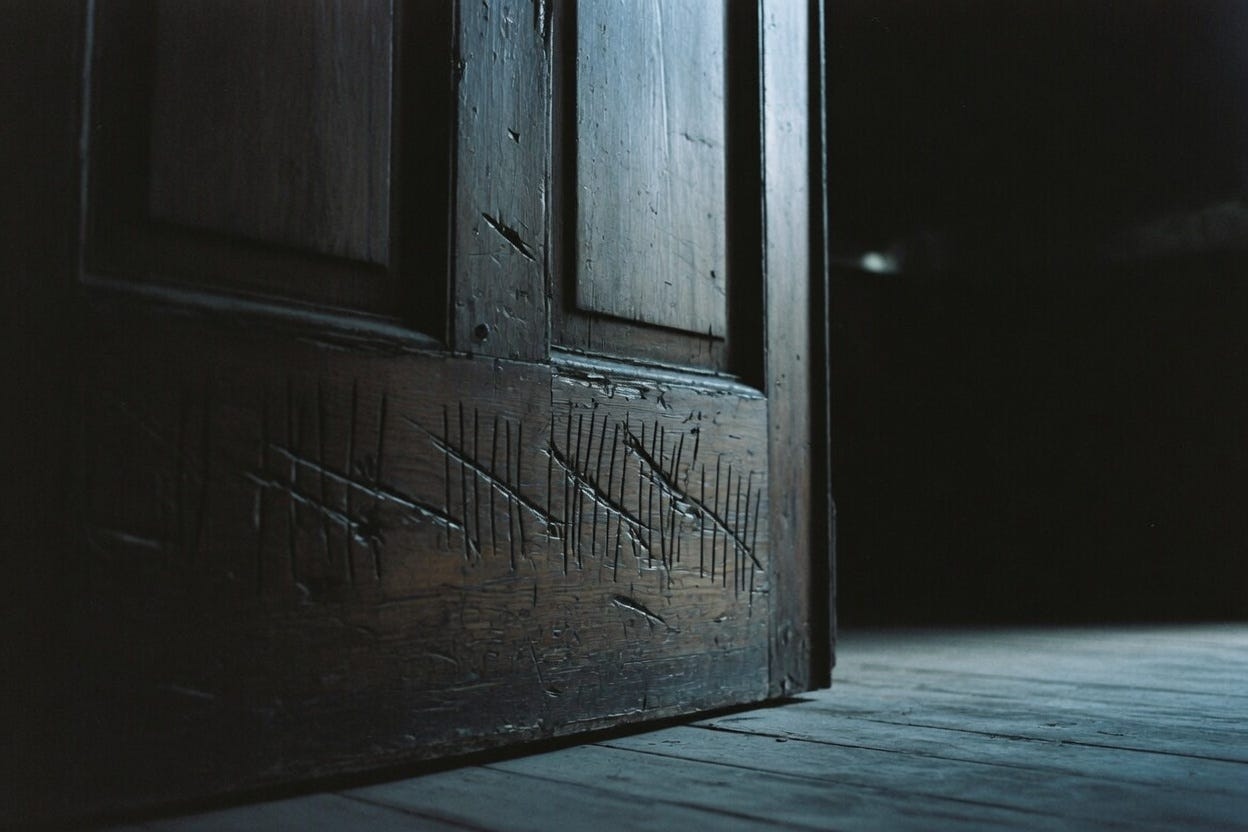
As you pass through the doorway you notice something on the inside of the frame, low down, near the floor. Marks scratched into the wood. You don’t stop to count them.
She walked past him into the corridor.
Morovka watched him watch her go.
He stood in the archive doorway for a moment after she’d passed, not moving, his cup finally empty because he’d set it down somewhere in the last hour without noticing. He was re-calibrating. Running the same calculation he’d been running since she arrived, adjusting variables, trying to decide on a category that fit.
He would get there eventually. The category he built would be wrong, but it would be functional enough to operate from for a while.
That was usually how it went.
Morovka had no particular feelings about this. It had watched the same process in many people, in many years, with many arrivals who turned out to be more or less than expected. It processed what it observed. It held what it held. It waited to see what the next thing would be.
The next thing, in its experience, was usually more of the same.
Usually.
Think of a moment when you knew there were others like you somewhere. Before you’d met them. Before you had any proof.
What did that feel like?