

Entry 02 - The Archive
She wasn't looking for anything. The room disagreed.
He holds her gaze for exactly as long as appropriate and not a moment longer.
Morovka noted the precision of this. It had watched the Keeper manage arrivals long enough to know the difference between composure and performance, and what he was doing now was closer to the second. The controlled withdrawal of attention. The slight adjustment of posture that said I am not unsettled in the particular way that only unsettled people bother to say it.
She had looked at him differently than the others. Not longer. Not harder. Differently - with the quality of someone who had found the edge of something and was quietly deciding what to do about it.
He didn’t know what she’d found. That was the part that had tightened his grip on the cup he was still, inexplicably, holding.
This one, he thought.
Still hadn’t finished it. Morovka, which had heard this particular unfinished thought from him before - about other people, in other years, with other cold cups - found it more interesting this time. The others had been performances of perception. People who noticed something was off and announced it, which was almost worse than not noticing. She hadn’t announced anything. She had gone quiet and alert, and the quality of that silence was not something he had a category for.
He was already building one. Morovka could see the shape of it forming.
Wrong category. It almost always was, at first.
You look away first.
Not because you’ve stopped seeing it. You haven’t, and something in you suspects you won’t. But continuing to look feels like a declaration you’re not ready to make. You turn toward the window instead. The curtains are heavy, burgundy, holding their shape without moving. You cross to them and pull one aside.
The garden.
You stand there longer than you mean to.
The plants are large in a way that feels less like someone grew them and more like someone stopped arguing with them a long time ago. Ivy in thick ropes along the stone. Flowers you don’t have names for. The grass long and completely unbothered. At the far edge where the garden meets the tree line, enormous roots have pushed up through the ground and arched back down, making shapes that could be doorways if you were that kind of person.
A breeze moves through it. Something white-flowered nods once and goes still.
The whole thing is somber and a little wild and completely, inexplicably, like something you’ve been trying to remember without knowing you were trying.
Shouldn’t you be more unsettled by this?
Apparently not. Your body has already voted and didn’t consult you.
You let the curtain fall.
The door is slightly skewed in its frame. You take the handle expecting a lock and find instead wood swollen into the frame, a sticking rather than a holding. You put your shoulder to it and push, and it gives.
Behind you, after a moment: the sound of the door opened with practiced ease. He knows exactly how much force it takes. Of course he does.
You don’t look back.
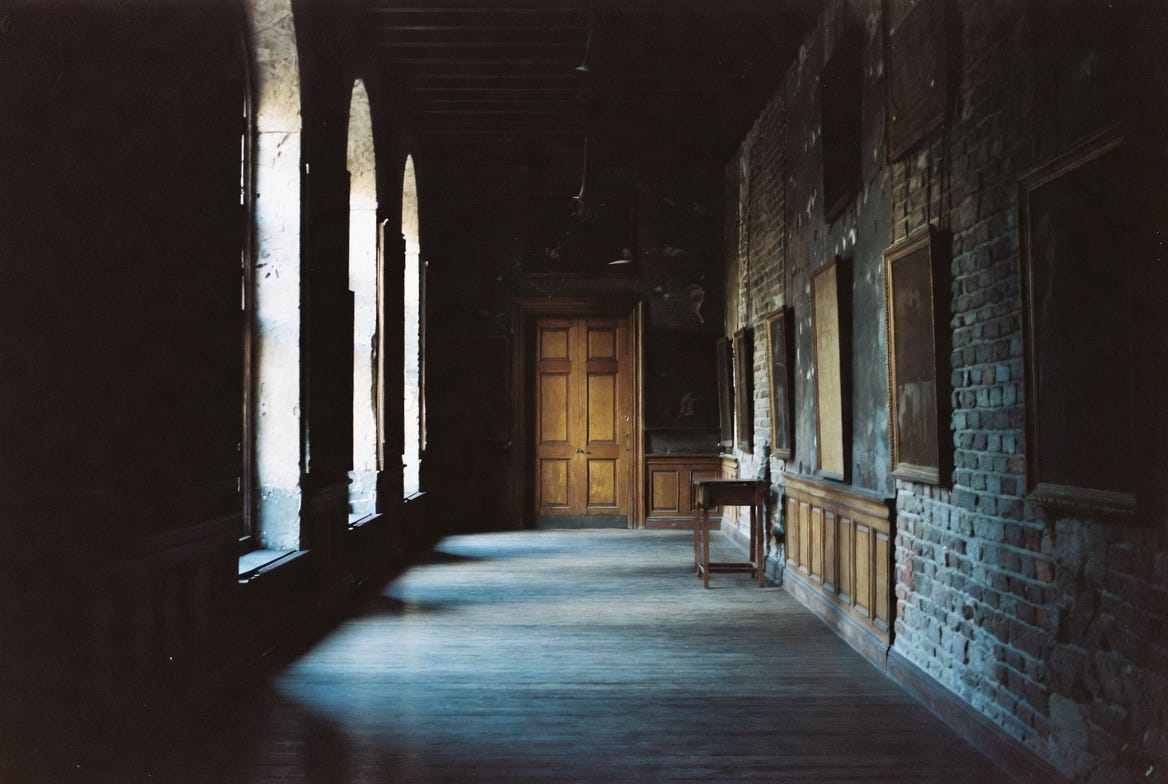
The corridor is longer than it should be.
Not impossible. Just slightly more than the outside of the building seemed to allow. You’ve already decided that keeping track of everything here that doesn’t add up is not going to be useful. You file it. Keep moving.
Dark wooden floors worn smooth in the center. Walls paneled and hung with things you don’t stop to examine yet. Light from tall arched windows, with glass old enough to distort what it shows. The house has a sound underneath its silence, low and persistent, felt more than heard. Something that has taken a great deal in over a long time without releasing much of it.
Behind you: footsteps. Not close. Not far. The specific rhythm of someone who is emphatically not following you.
You don’t turn around.
The smell shifts as you move deeper. Something warm and dry, stronger here, as though the house breathes from a single source somewhere near its center. You follow it without deciding to.
She was navigating by something he couldn’t see.
Morovka watched him realize this and then immediately suppress the realization, which was what he did with things he didn’t have a category for. He was good at it. Years of practice.
She’d slowed before two turns she couldn’t have anticipated. She moved through the house the way people moved when they were following something interior, and watching it was doing something to his carefully maintained distance that he hadn’t noticed yet.
He was at sixteen paces. He usually kept twelve.
His cup was still in his hand. He’d forgotten he was holding it.
Morovka noticed. Morovka noticed most things. It had been noticing things for long enough that very little produced anything resembling surprise anymore. This produced something in the realm of interest, which was not nothing.
She turned down the east passage.
The Keeper stopped walking. Stood there looking at the space where she’d been. Then he followed, four paces further back than usual, which he also hadn’t noticed.
Morovka said nothing. As usual.
The door is at the end of a turn you almost didn’t take.
Not hidden. Not marked. Just there, in the way certain things are there when you’ve been moving toward them without knowing it. The handle is brass, with a smooth grip. Your hand fits it without adjustment.
You open it.
The smell greets you first. Paper and old ink and the specific dryness of things kept in the same air for a long time. Not neglected - tended. Underneath it that warm dry Sandalwood note again, strongest here, as though this is where the house keeps its source.
You step inside.
Not large. Full - not cluttered, full the way a sentence is full when nothing in it is wasted. Shelves floor to ceiling, and on them: documents in folders, things bound in cloth, things rolled and tied, objects you have no immediate context for. A long table down the center. A lamp on, its source not immediately obvious.
You move along the nearest shelf slowly, fingers trailing without pulling anything out. Something about the room makes you want to know what you’re reaching for before you reach.
Your hand slows at a particular section.
The objects here look like the others. The quality is different. Held rather than stored, like these things arrived the way you arrived - without quite knowing how, and have been here since.
You pick up the nearest one.
Small. Printed. Black cover, spare. More Than ___. The blank where a word should be and isn’t. You open it.
The writing is direct and doesn’t waste your time. Built around a specific life - a woman carrying more than one role, more than the world’s tidy categories want to account for - but it addresses you with a precision that has nothing to do with whether the particulars match. You read until you reach this:
They know this one. They’ve seen it before. And before you’ve said anything else, the category closes around you. Everything that doesn’t fit gets quietly, almost lovingly, compressed out of view.
You stop.
Compressed. The word lands somewhere specific - not in your head but lower, in the place where you’ve felt again and again, without ever having the right word for it, the particular pressure of being made to fit. The almost-loving quality of it. How that makes it harder to name than if it were just cruel.
You keep reading. And near the end you find this:
The hyphen is not a fracture. It’s a bridge.
You don’t move for a moment.
Then you set it back carefully, exactly where it was.
You take two steps and see a stack of paper tucked between two books too fragile to be opened. The Hyphen. Different in form - structured around questions, constraints, the logic of something that wants you to locate yourself in places you’ve been avoiding. You start to follow it and then the room shifts.
Not a sound. Just a change in the air at the threshold, the space adjusting for a second presence.
You set it back. You’ll come back to it.
He’s in the doorway. Not inside - at the threshold. Same posture as always. Face giving nothing away.
But the timing is slightly off, the kind of fraction most people smooth over without registering. His stillness has increased, which in your experience means something underneath is working harder. You feel it in the air between you more than see it anywhere you could point to.
He knows you found something in here.
He doesn’t know yet what that means.
Neither do you.
“You found the archive,” he says. Not a question. The words land exactly on time, which is the tell - built to give nothing away, which is itself something given away.
“What is it?” you ask.
A pause. Short.
“Things that are kept here. Not everything. Enough.”
You look back at the shelves. At The Hyphen sitting where you left it. At the lamp whose source you still haven’t located.
Enough for what.
The question sits in your chest, not quite ready. You almost say it. Then you don’t.
Think of something you’ve held onto - a document, an object, a memory - that you didn’t fully understand but couldn’t put down.
What did you sense was in it?
I like the way you build a sense of deliberate ambiguity by constantly side-stepping meaning. I enjoy the read then I'm left with a disturbing and tantalising impression of having almost understood.